Who must issue the DeCA: both parties, and in Odoo you decide it on each delivery order.
The DeCA binds both the contractual shipper and the actual carrier, even if you own no trucks. Five questions to find out which one you are and how it shows on each Odoo delivery order.
Who must issue the DeCA has a short answer: two companies at once, the cargador contractual (contractual shipper) and the transportista efectivo (actual carrier). Since 5 October 2026, the Documento electrónico de Control Administrativo (DeCA), Spain's electronic administrative control document, is mandatory for public road freight inside Spain. This guide shows which role you play and how it shows in Odoo.
The DeCA binds both the contractual shipper and the actual carrier.
Article 4 of Orden FOM/2861/2012 obliges two parties to formalise the document:
Actual carrier: the holder of the authorisation under which the transport is physically carried out. They supply the truck.
Contractual shipper: whoever contracts directly with the actual carrier. The order names other carriers, cooperatives, agencies, freight forwarders, warehouse distributors and logistics operators.
So a distributor with no fleet is a contractual shipper. Issuing it is covered in our guide to the DeCA in Odoo.
Five questions to know whether the DeCA is mandatory for your shipment.
Answer in order; each question can end the path:
Do you move goods by road? If not, the DeCA does not apply to you.
Are origin and destination in Spain? International transport is out (CMR or eCMR). Cabotage does need a DeCA.
Is the shipment exempt under article 2.1? Small parcel deliveries, removals or broken-down vehicles: no DeCA.
Are the goods yours? If the truck and driver are yours too, it is complementary private transport (transporte privado complementario): no DeCA. If the truck belongs to someone else, you are the contractual shipper.
Do the goods belong to a third party? If you carry them in your own truck, you are the actual carrier. If you subcontract, you are the contractual shipper towards whoever you subcontract.
The quick DeCA question: who pays the transport invoice?
If you pay a third party to carry the goods, you are the contractual shipper on that shipment.
Contractual shipper or actual carrier: what each one answers for in the DeCA.
Article 7 splits the eight data items of article 6:
Contractual shipper · Answers for: a) own name and tax ID, b) name and tax ID of the actual carrier, c) origin and destination, d) nature and weight · What they do: Usually prepares the document before departure and keeps it for at least one year
Actual carrier · Answers for: e) special driving authorisation, where applicable, f) transport date, g) tractor and semi-trailer plates · What they do: Supplies their data, carries a copy on board, keeps it one year
Either · Answers for: h) remarks and reservations · What they do: Added by whoever asks for them
The Resolution of 5 June 2026 requires both parties to be identified "expressly and separately". A single customer on the document is not enough.
Who issues the DeCA in practice.
The order does not say who physically produces the document, as the FAQ of the Ministry of Transport and Sustainable Mobility confirms. Both are liable if it is not on board, unless the contractual shipper proves it was issued (article 7.1).
Hence the usual flow, and the one we follow at Dynapps: the contractual shipper issues it, since they already hold four of the eight data items and gain proof of issue. The actual carrier completes e, f and g and carries their copy (article 8 requires two).
Borderline cases that raise questions about the DeCA.
Goods of another group company: they count as third-party goods.
Subcontracting: whoever subcontracts becomes the contractual shipper.
Complementary private transport: no DeCA, but you must carry documents that prove it (LOTT, article 102.2).
Few packages, article 2.1 d): there is no numeric threshold; your business decides.
International with CMR or eCMR: outside the DeCA.
Removals and broken-down vehicles: exempt (article 2.1 b and c).
Returns: a return is another transport and needs its own DeCA.
What changes with the DeCA if you use Odoo.
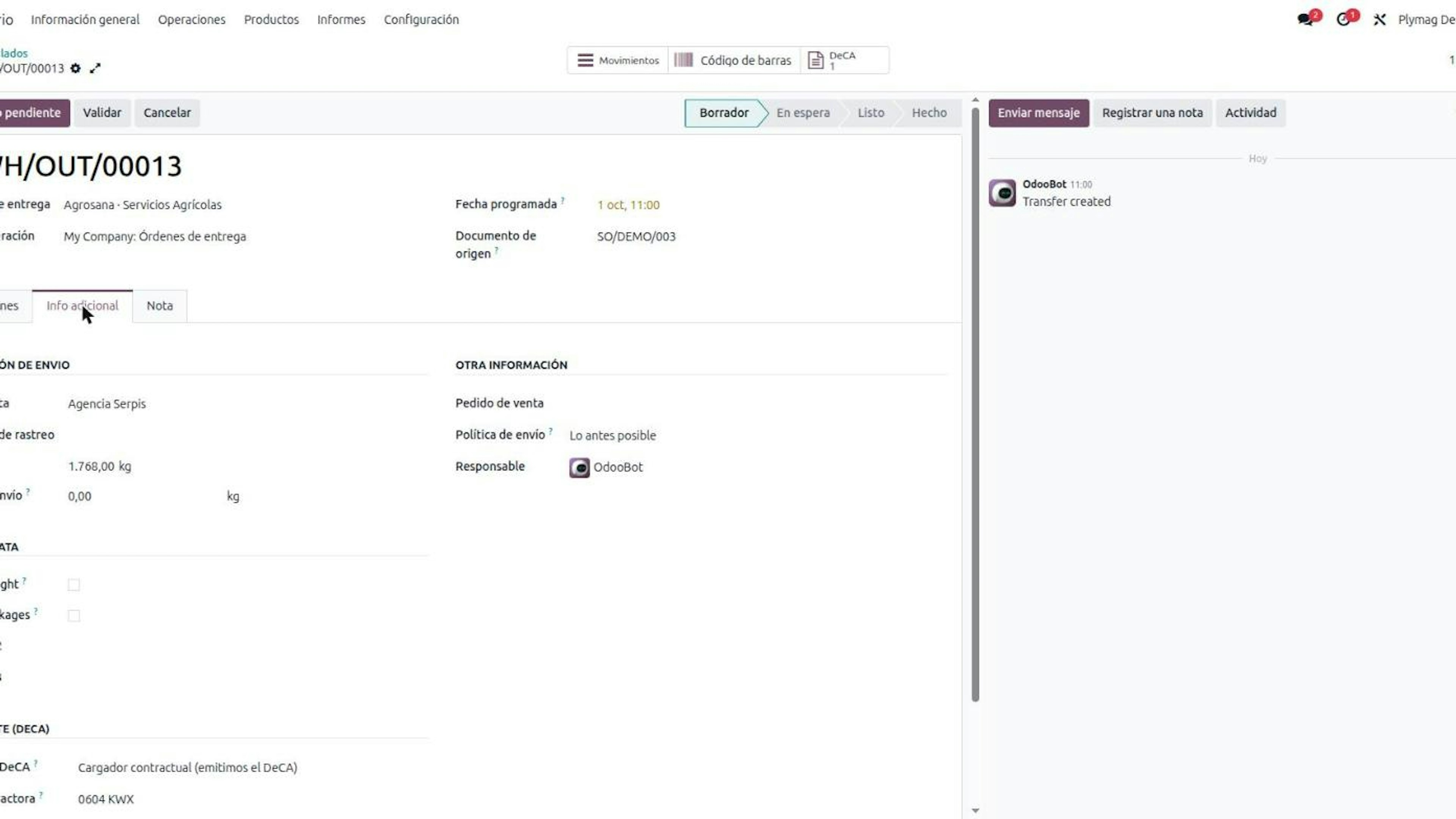
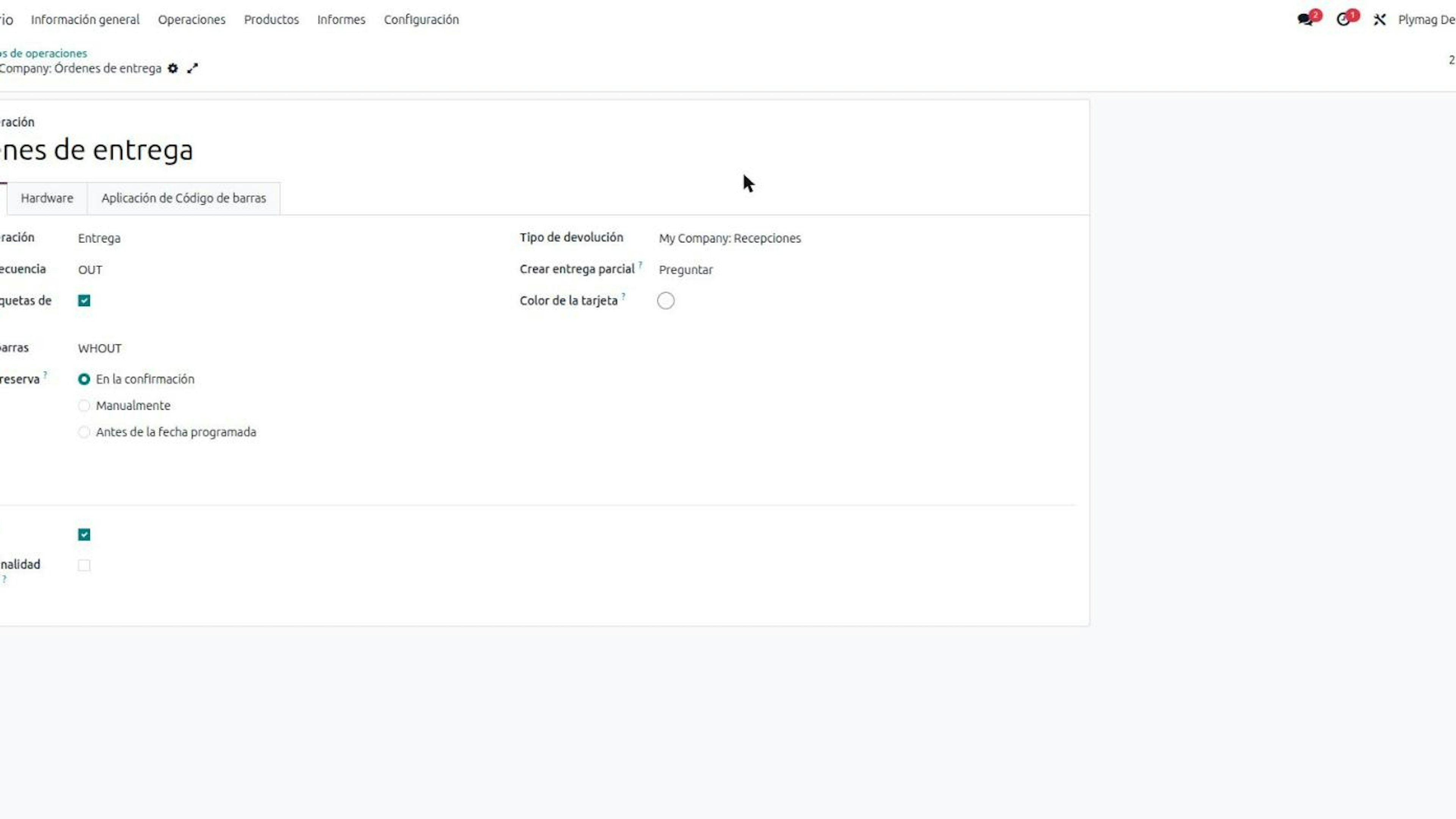
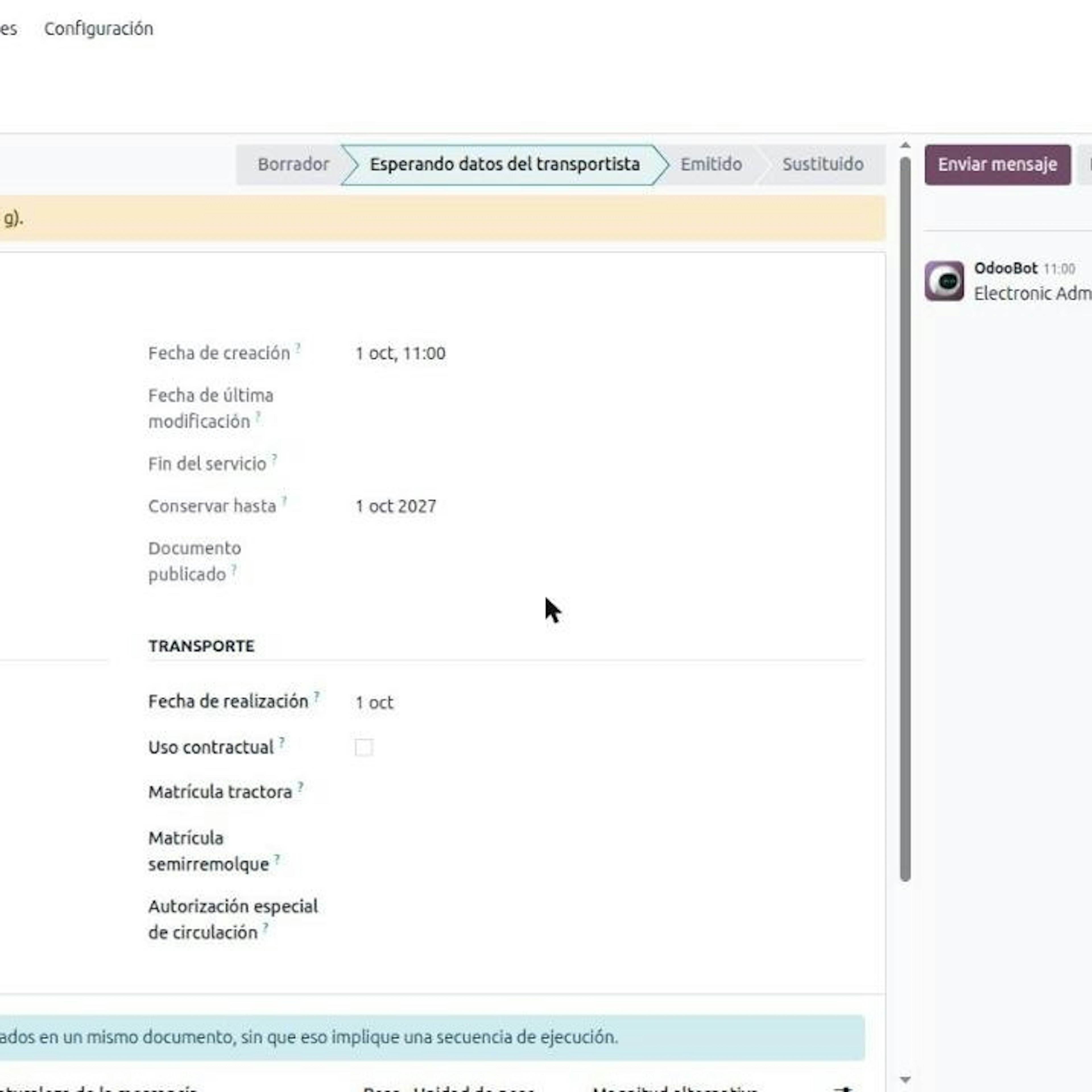
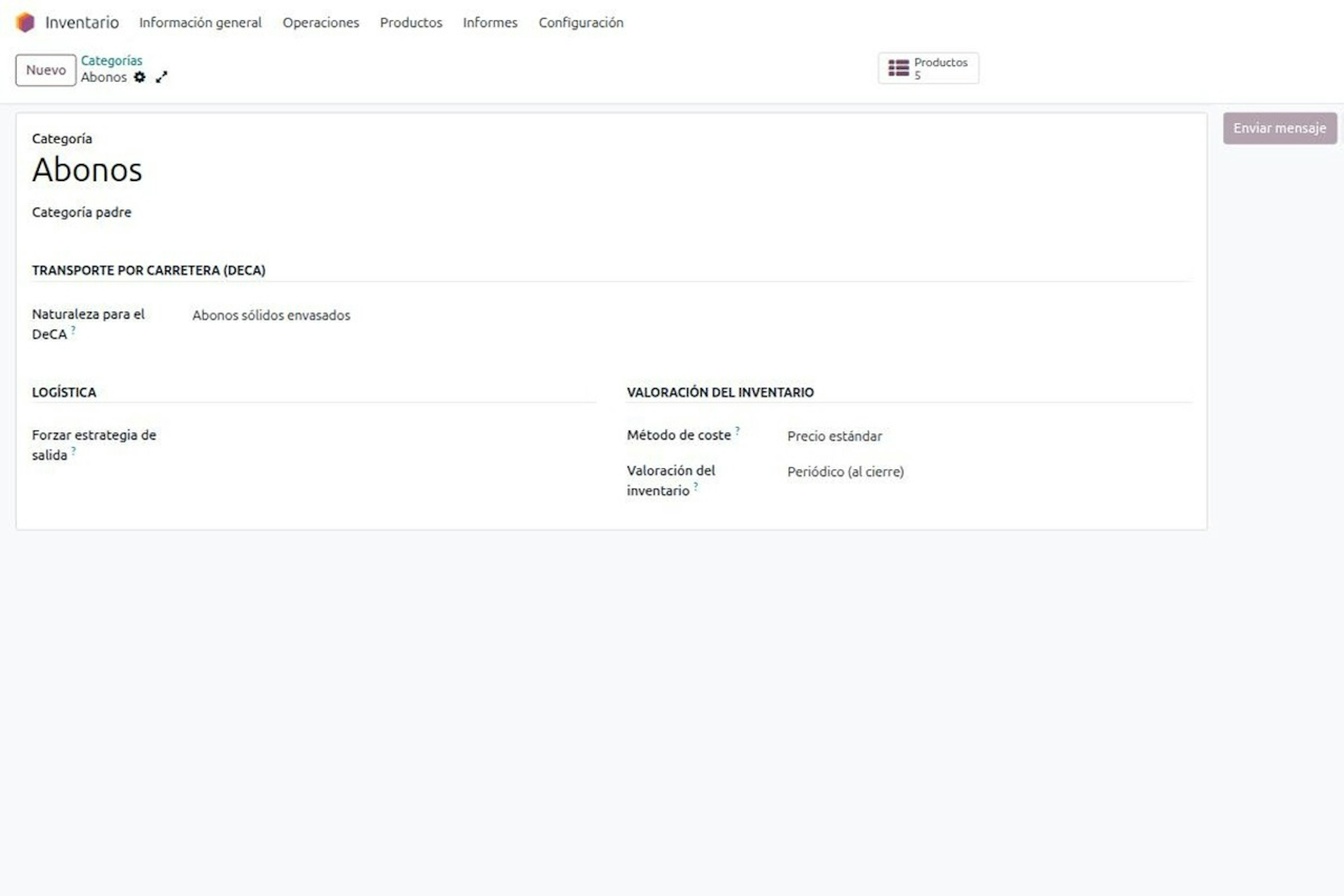
Standard Odoo does not include the DeCA. With the Dynapps functionality, your company's role is set on each delivery order, in the field Role in the DeCA: contractual shipper, exempt (article 2.1) or actual carrier. It sits on the delivery order, not the operation type, because the exemption depends on the load.
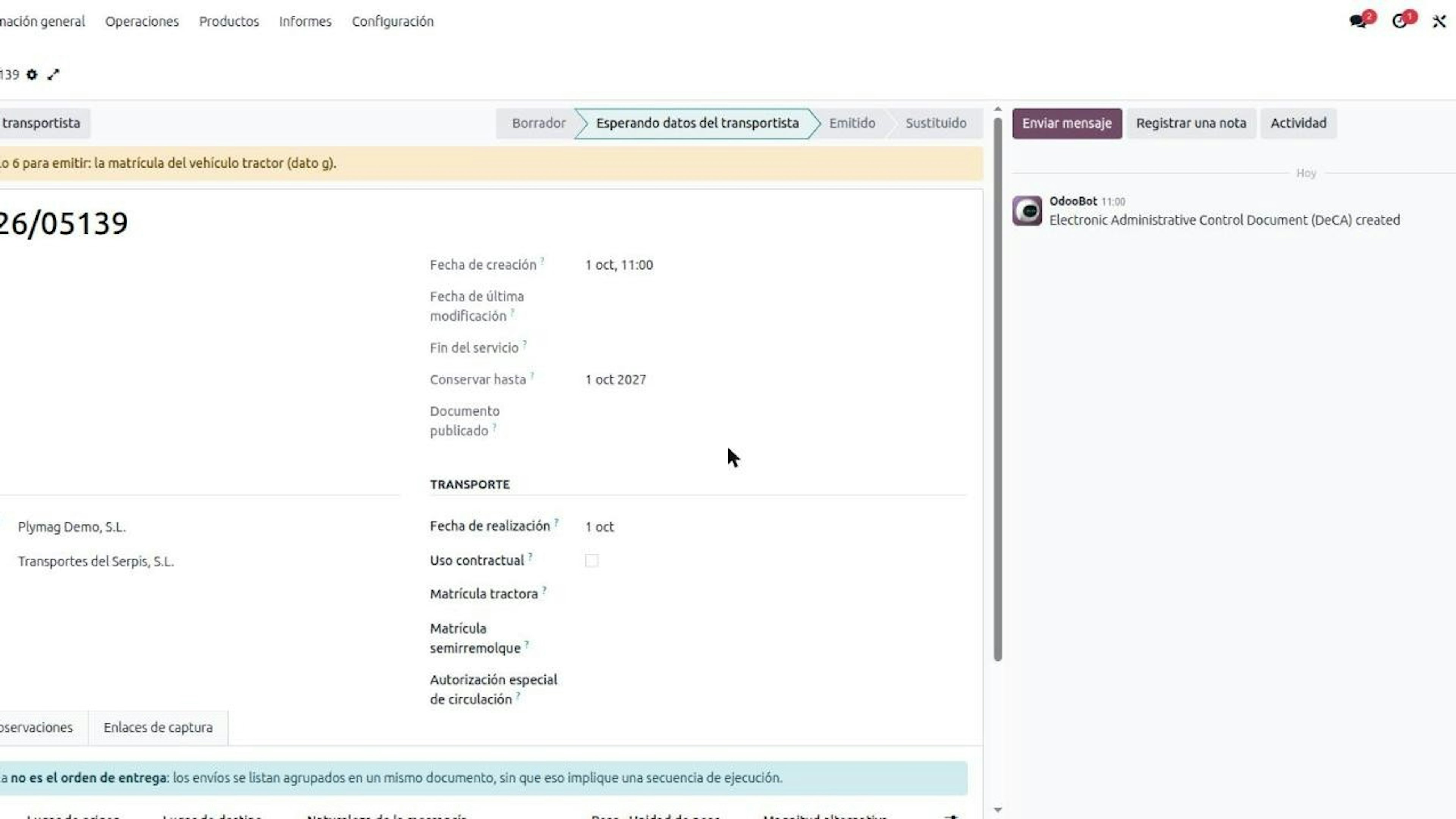
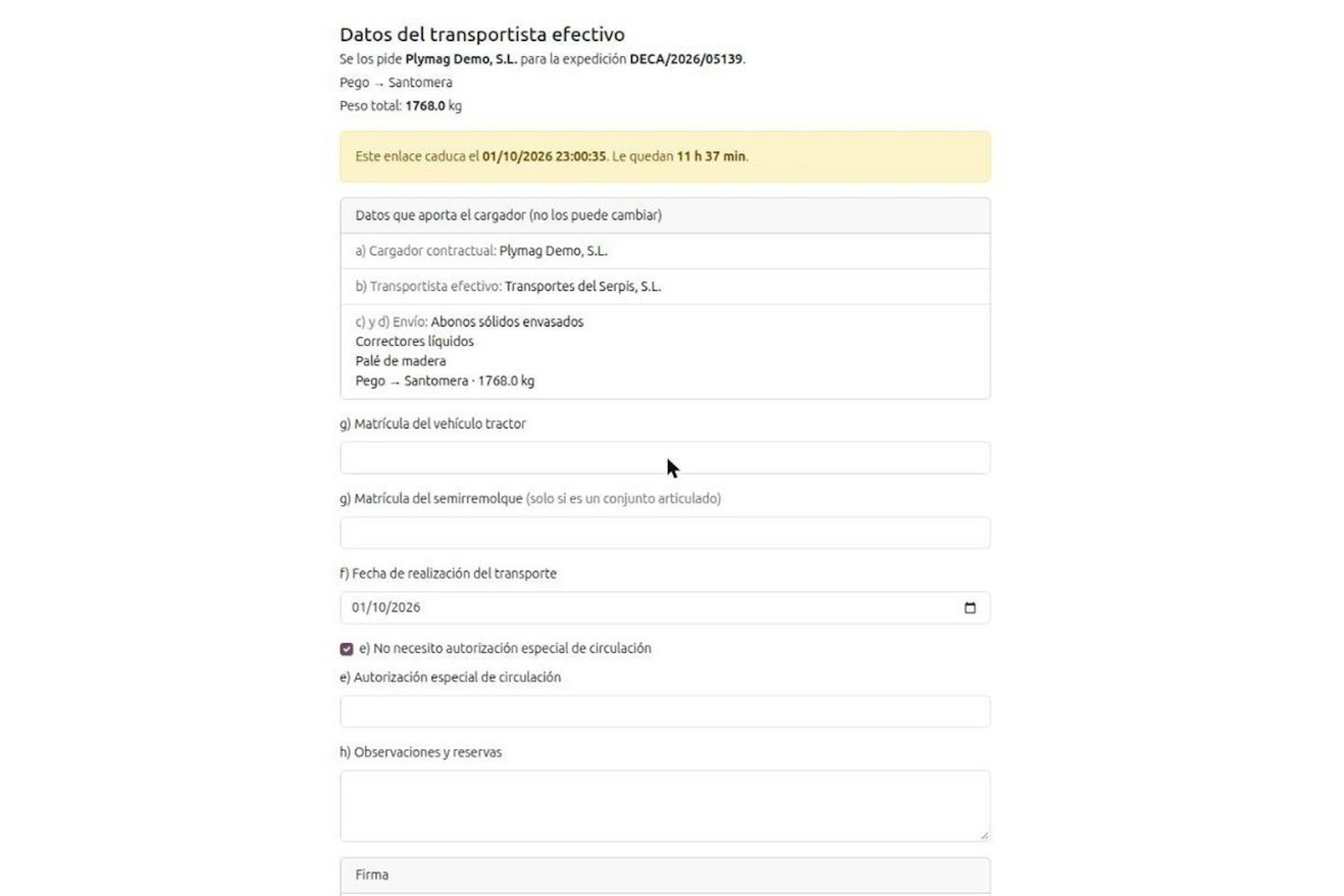
The operation type only carries Uses DeCA, which shows the fields. With the contractual shipper role, validating the delivery order requires an issued DeCA; if the plate is missing, it stays waiting for the carrier, who supplies it through a capture link with a six-digit PIN, with no user in your Odoo.
Continue with the DeCA for distribution companies if you have no fleet, or with the DeCA for transport companies using Odoo if you are the actual carrier.
DeCA penalties reach both parties.
The LOTT, Spain's land transport act (articles 140 to 143), penalises both the contractual shipper and the actual carrier. The ministry confirms on its DeCA page that there is no penalty-free phase after 5 October 2026.
Frequently asked questions about the DeCA and who must issue it.
We are a distributor with no trucks and an agency moves our pallets. Are we obliged to issue the DeCA?
Yes. If you pay an agency or a carrier to move your goods inside Spain, you are the contractual shipper and the Documento electrónico de Control Administrativo (DeCA) applies to you. Article 4 of Orden FOM/2861/2012 names warehouse distributors and logistics operators, and you answer for data items a, b, c and d. Shipments exempt under article 2.1, such as small parcel deliveries, are out. Before going live in Odoo, what saves most time is tidying the master data: the nature of the goods on the product category and the carrier on each shipping method. Then the document leaves the delivery order with almost everything filled in.
We are a haulier and subcontract some trips. Who is the contractual shipper on the DeCA?
You are. When carrier A subcontracts carrier B, B is the actual carrier on the Documento electrónico de Control Administrativo (DeCA) and A is the contractual shipper. The FAQ of the Ministry of Transport and Sustainable Mobility explains it with the definitions of Orden FOM/2861/2012: liability falls on whoever physically carries out the transport, the last link in the chain, and on whoever hires them. Article 4 even lists another carrier among possible contractual shippers. The authorisation sets the limit: the actual carrier is its holder. If you use your own truck on one trip and subcontract another, your role changes from shipment to shipment.
We use our trucks to carry goods for another company in our group. Is that complementary private transport, with no DeCA?
No. Goods of another company in the same group count as third-party goods. Complementary private transport, governed by article 102.2 of the LOTT, requires the goods, the vehicle and the driver to belong to your company. Only then does the Documento electrónico de Control Administrativo (DeCA) not apply, because Orden FOM/2861/2012 covers public transport, and even then you must carry documents that prove it. With a sister company's goods and your own truck, on that shipment you are the actual carrier, not the shipper. Check with your adviser which authorisation covers that transport, because the role depends on it. And keep the document for one year, like any actual carrier.
We often send three or four boxes by courier. Is there a number of packages below which no DeCA is needed?
There is no number. Article 2.1 d) of Orden FOM/2861/2012 exempts from the Documento electrónico de Control Administrativo (DeCA) parcel services of "a small number of packages" that one person can handle alone. The FAQ of the Ministry of Transport and Sustainable Mobility confirms that going digital does not change this exemption. No rule sets the boundary, so you decide it and should write it down. In Odoo this means marking the delivery order as exempt, and by default no delivery order is. Setting that rule and teaching it to the warehouse before go-live stops shipments from leaving without a document.
We export with CMR. Do we also need the DeCA or the eCMR from 5 October?
For international transport you do not need the Documento electrónico de Control Administrativo (DeCA), and the eCMR does not become mandatory. The FAQ of the Ministry of Transport and Sustainable Mobility says so expressly: under article 222 of Royal Decree 1211/1990, the DeCA applies to domestic transport, that is, national transport and cabotage. International transport uses the documents of the conventions Spain has signed, such as the CMR. The limit is shipments with origin and destination in Spain: those do need a DeCA, also when a foreign carrier performs cabotage. If you mix domestic and international work, decide the role shipment by shipment.
Who has to issue the DeCA, the shipper or the carrier?
The rule binds both and does not say who physically produces it. The FAQ of the Ministry of Transport and Sustainable Mobility makes it clear: Orden FOM/2861/2012 obliges the contractual shipper and the actual carrier to formalise the Documento electrónico de Control Administrativo (DeCA), and both are liable if it is not on board unless the shipper proves it was issued. That is why the usual flow is for the contractual shipper to issue it with data items a, b, c and d, and for the actual carrier to complete e, f and g. Both keep their copy for one year. The rule does not settle what happens to an issued document if the service is cancelled.
Sort out your role in the DeCA and bring it into your Odoo.
At Dynapps we have 150+ customer references in Spain, and we are an Odoo Gold Partner with ISO 27001. We help you set your role per flow and issue the DeCA from the delivery order. Request a demo of the DeCA in Odoo
More posts like this
13-minute read
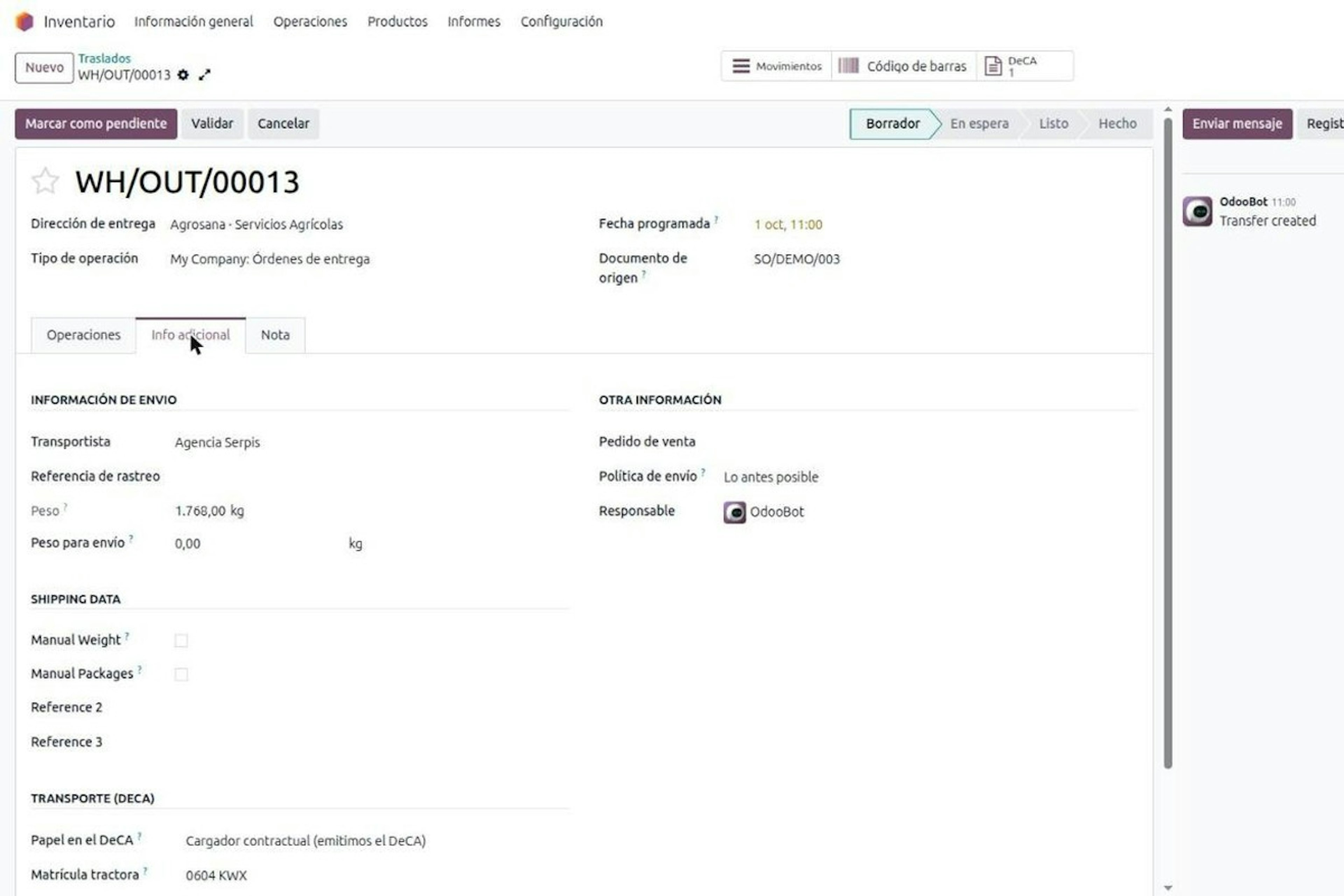
DeCA in Odoo: the transport control document, issued from the delivery order.
The DeCA is mandatory from 5 October 2026. If you run Odoo, you issue it from the delivery order with no separate tool, and the carrier adds the plate from their phone.
8-minute read
DeCA in Odoo for distribution companies: comply even without trucks.
If you distribute with Odoo and contract the transport, the DeCA binds you even if you own no truck, and you will usually be the one issuing it. What data you supply, why it is already on your delivery order and what daily work looks like.
8-minute read
DeCA for transport companies with Odoo: you supply your data by link and issue it when you subcontract.
As the actual carrier, the DeCA binds you, but you will usually supply the special authorisation, date and plates through the link your client's Odoo sends you. When you subcontract, you will normally issue it from your own Odoo.