What is Odoo?
The ERP that will revolutionize your business.
Comprehensive, all-in-one management.
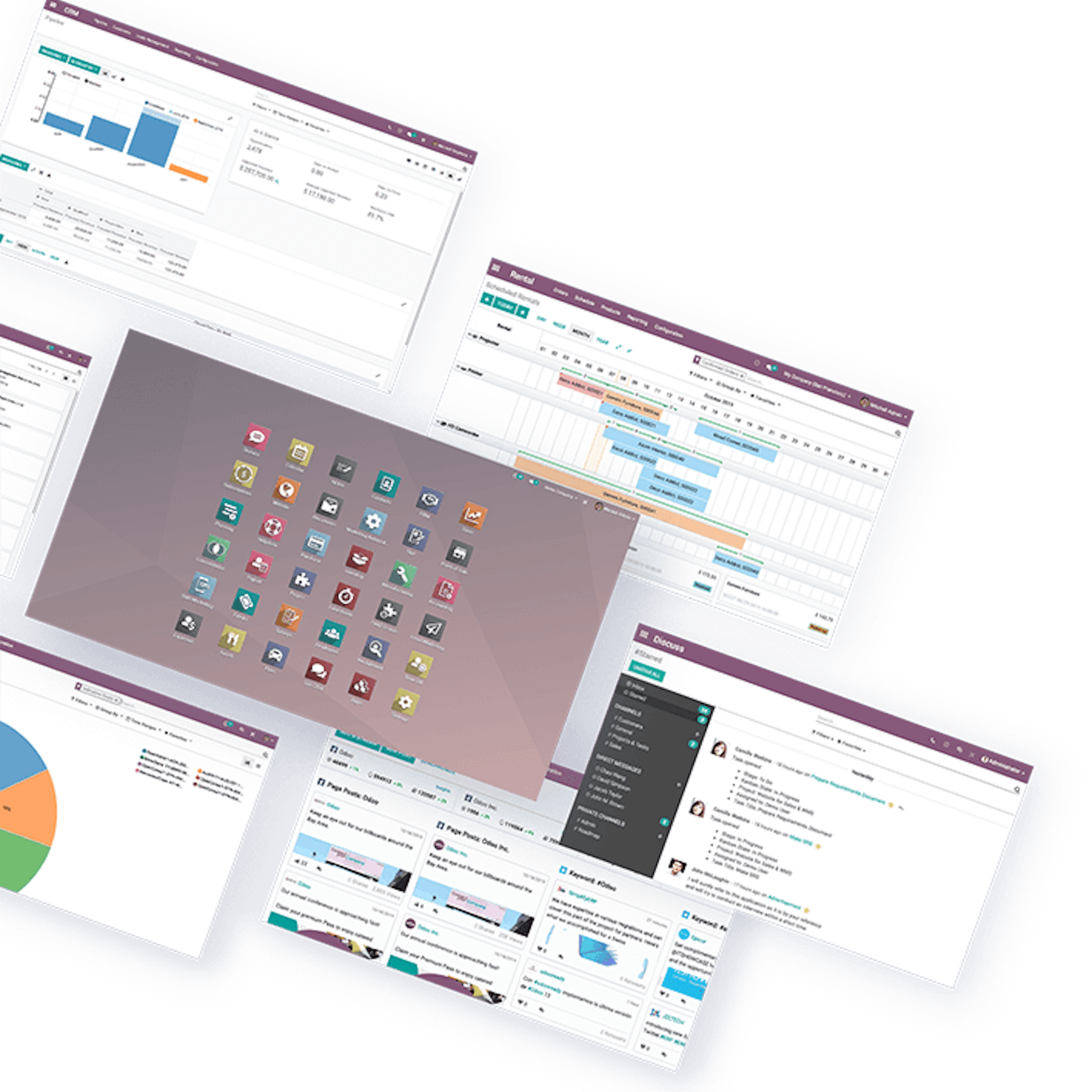
What is Odoo?
Odoo ERP is the Odoo ERP system A free business management solution capable of meeting all your business needs, thanks to the integration of its many applications: Odoo CRM , accounting, inventory, online marketing, project management, human resources, etc.
Odoo has an app for every need, bringing everything together on a single platform you a customized, cost-effective, and modular solution, which will enable your organization to save time and resources, managing your business in a unified way.
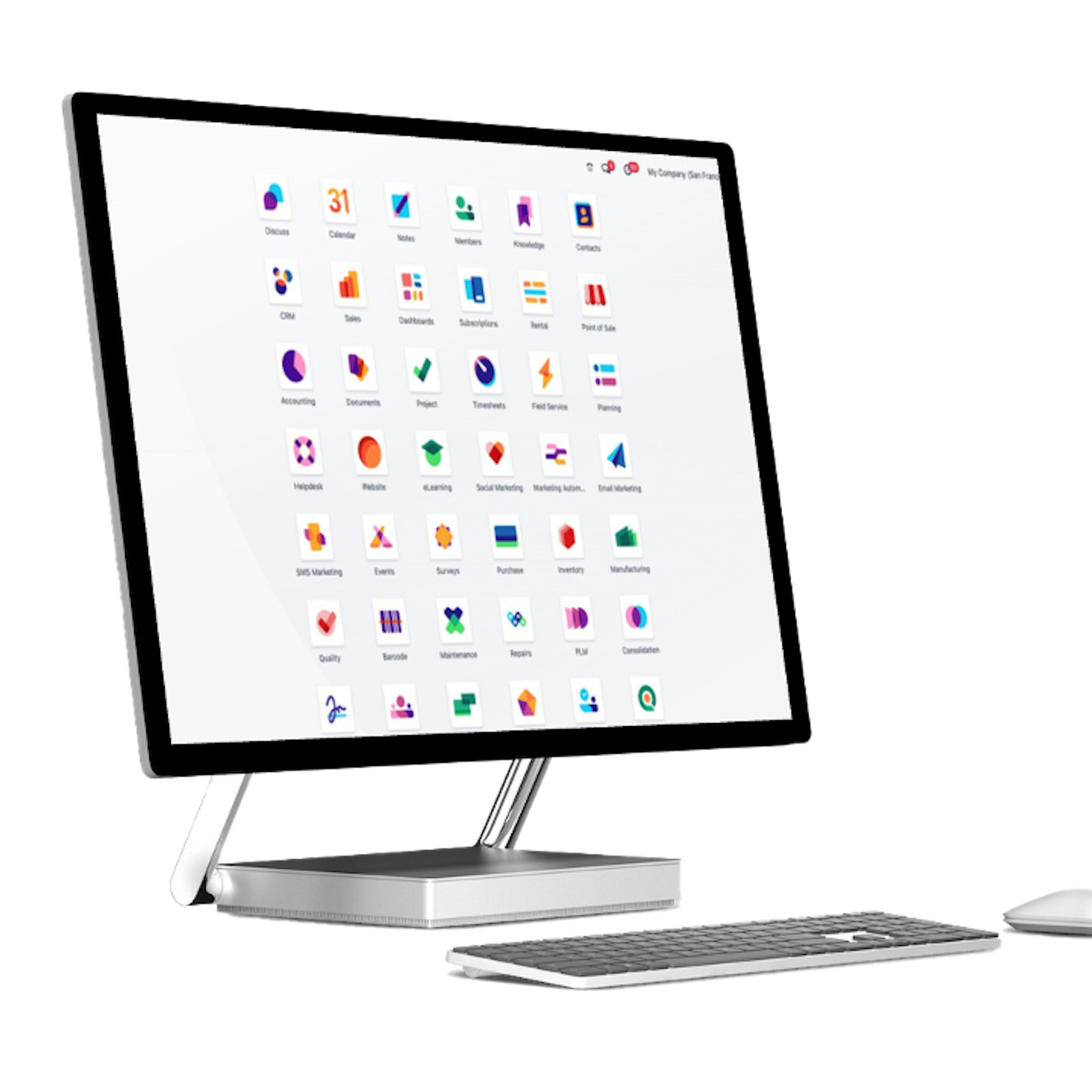
Odoo applications: a solution for every need.
All Odoo applications are fully integrated and they communicate with each other.
Forget about the integrations conflict-prone and achieves a exceptional user experience.
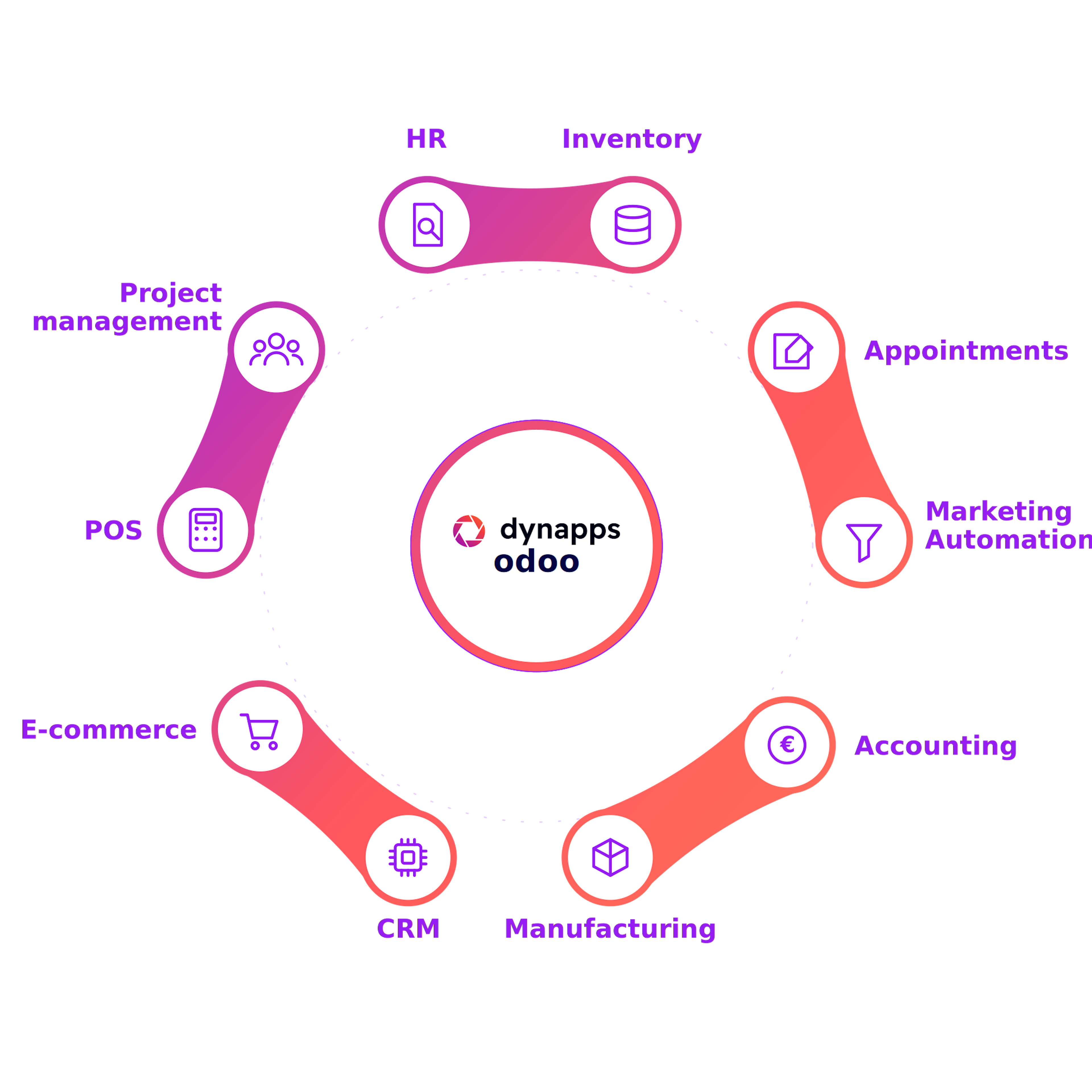
And much more...
Discover the ideal ERP for your business.
What is Odoo used for?
Centralize, adapt, and grow your business with Odoo.
Inclusion and accessibility
Manage all your company's needs in a centralized, online manner that's accessible from any device, promoting telework.
Usability and adaptability
Its customizable, accessible, and intuitive design will save your company time and resources.
Development and growth
Thanks to regular updates and the release of new versions of Odoo, You'll be able to quickly address any new needs that arise in your business.
2005
Since 2005 (* Tiny ERP, Open ERP, and Odoo)
42
Custom applications
+20,000
Programmers
+12M
Users
They trust Odoo great companies partner with great companies.



More than 16 million users have grown their businesses with Odoo software.
Ask us for a quote or request your personalized demo with no obligation.
Odoo is essentially an all-in-one business management software solution. It is a comprehensive suite of open-source business applications. Odoo allows you to use various features such as CRM, sales, inventory, reporting, accounting, invoicing, website, e-commerce, email marketing, and many more all on a single platform. All Odoo applications are fully integrated and communicate with one another.
The easiest way is to start a free demo at https://www.odoo.com/es_ES/trial or request a demo from one of Odoo's official partners.
You learn Odoo by doing; however, you can access free Odoo courses offered by its creators at https://www.odoo.com/es_ES/slides. To learn in Spanish, we recommend our platform Dynapps Academy: More information here
The time required for an Odoo implementation varies widely. Given Odoo’s modular nature, a project may involve one module or as many as a dozen. Therefore, to estimate the average time required for an Odoo implementation, we need to know the number of modules and customizations required for the project.
As a rough estimate, we can say that it takes 2 to 4 weeks per implementation. This timeframe includes the installation, configuration, and training required for the successful implementation of an Odoo project.
There are several costs to consider when calculating the total cost of Odoo.
Licensing costs: Odoo offers a Community version, where licenses are free but features are more limited, and an Enterprise version with fairly affordable licensing costs per application and user.
Hosting costs: Odoo can be hosted on your own cloud servers or on the Odoo.sh platform.
Implementation Costs: We recommend working with a local partner for Odoo implementation, given the specific accounting requirements of each country. The implementation cost will be directly related to the number of consulting and development hours required to complete the project.
To estimate the cost of Odoo, go to the pricing calculator:
Fabien Pinckaers' answer to this question was as follows:
Short answer: It means nothing.
Long answer: When we had to choose a new name for TinyERP, we purchased two domains: OpenERP.Com and odoo.com. We bought both, just in case, and ended up choosing the wrong one (OpenERP).
A few months later, we discussed using odoo.com for the OpenERP online offering, but we never did so in order to avoid splitting the brand (Odoo could have been an acronym for On Demand Open Object). OpenObject was the name of the OpenERP framework at the time, but we no longer use that name.
The official—and more fun—answer is here: https://www.odoo.com/blog/5/post/156
Fabien Pinckaers is the founder and CEO of Odoo, the company behind the enterprise resource planning (ERP) software of the same name. From a young age, Pinckaers showed a strong interest in software development and entrepreneurship. His passion led him to create TinyER, the precursor to Odoo.
The open-source approach has been crucial in building an active community and expanding the reach and capabilities of Odoo software, making it accessible to companies of all sizes around the world.Odoo started as Tiny Erp in 2005, in 2008 it was renamed to Open Erp and in 2014 to Odoo, the name by which we know it today. It's funny how users call it and write it in different ways Odu, Oddo, OOdo, but they all refer to the best open source enterprise software.
An ERP (Enterprise Resource Planning) system is software that integrates a company's main operational functions such as sales, purchasing, accounting, and human resources into a single system to optimize processes and facilitate decision-making. It enables centralized management of data and resources, improving efficiency and productivity.
More than 16 million users have grown their businesses with Odoo software.
Ask us for a quote or request your personalized demo with no obligation.